


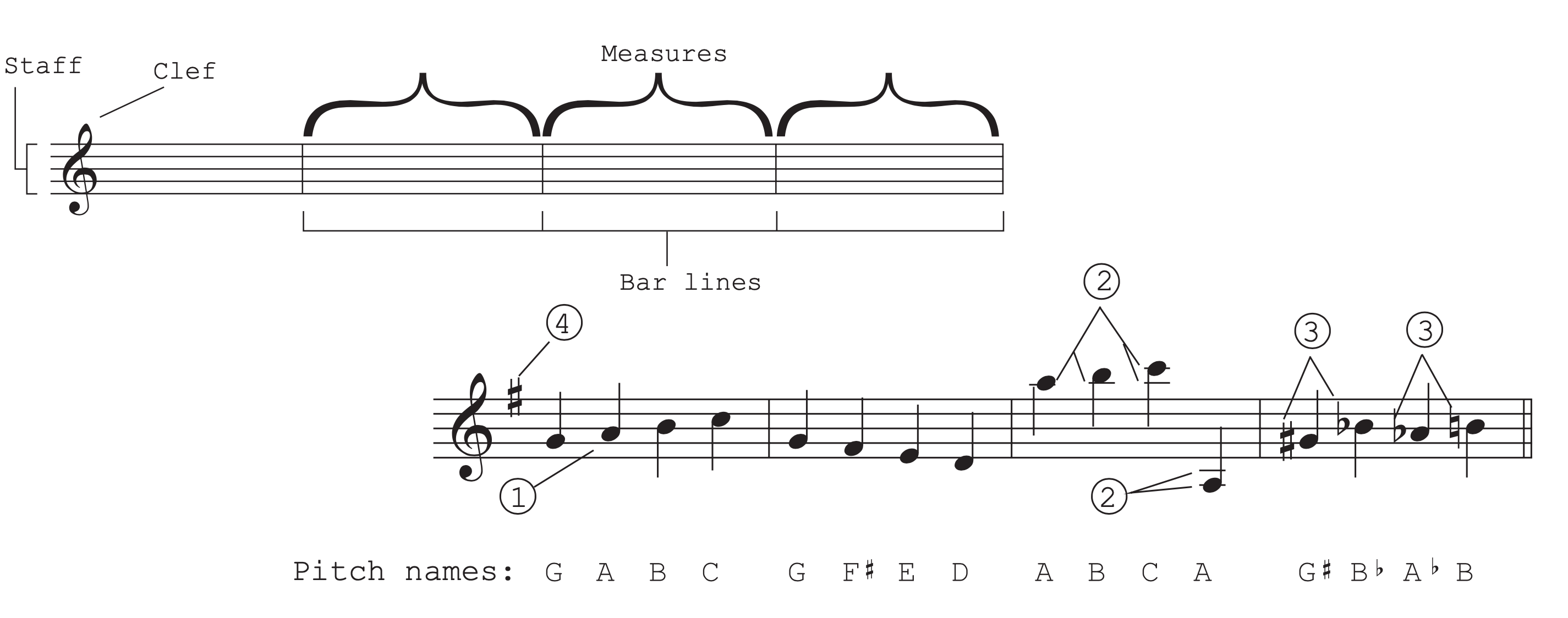
1 note
A musical symbol whose position on the staff indicates its pitch and whose shape indicates its duration. The notes on the five lines of the staff (from bottom to top) are E, G, B, D, and F. You can remember these using the saying “Every Good Boy Does Fine.” The notes placed on the four spaces in between the lines (from bottom to top) spell out the word face (F, A, C, and E).
2 ledger lines
Notes can fall above or below the staff as well as within the staff. To indicate a pitch that falls higher or lower than the staff, use ledger lines, which you can think of as short, temporary staff lines. Note names progress up or down the ledger lines (and the spaces between them) the same way they do on the staff lines. So, for example, the first ledger line below the staff is C, and the first ledger line above the staff is A. Try counting down two notes from the bottom line E and up two notes from the top line F to verify this for yourself.
3 sharps, flats, naturals, and accidentals
The first seven letters of the alphabet — A through G — make up the natural notes in music, the white keys of the piano keyboard. In between some of the natural notes (white keys) are other notes (the black keys) that don’t have names of their own. These notes are known as sharps or flats and are named according to their adjacent natural notes by adding either a sharp symbol (#) or flat symbol (H) after the letter name. When you see F# in music, you play F one half step (one fret) higher than natural F. For a note with a flat symbol, such as DH, play the note one half step lower than the natural version. A natural sign (J) restores a note that’s been modified by a sharp or flat to its natural state — it cancels the sharp or flat. Accidentals are notes outside the key (defined by the key signature) and are indicated in the music by the appearance of a sharp, flat, or natural sign modifying a note. An accidental holds for all the notes of that pitch for the rest of the measure.
4 key signature
The listing of flats or sharps at the beginning of the staff, immediately to the right of the clef, tells you which notes to play flat or sharp for the entirety of the piece (or at least a major section of the piece), unless otherwise indicated with an accidental. For example, the music in Figure 4-2 has a key signature of one sharp — F#. That means anytime you encounter any F (whetherin the staff or on a ledger line), you play it a half step (one fret) higher. In other words, the key signature sends out the loud and clear message: “All Fs are hereby sharped until further notice!”
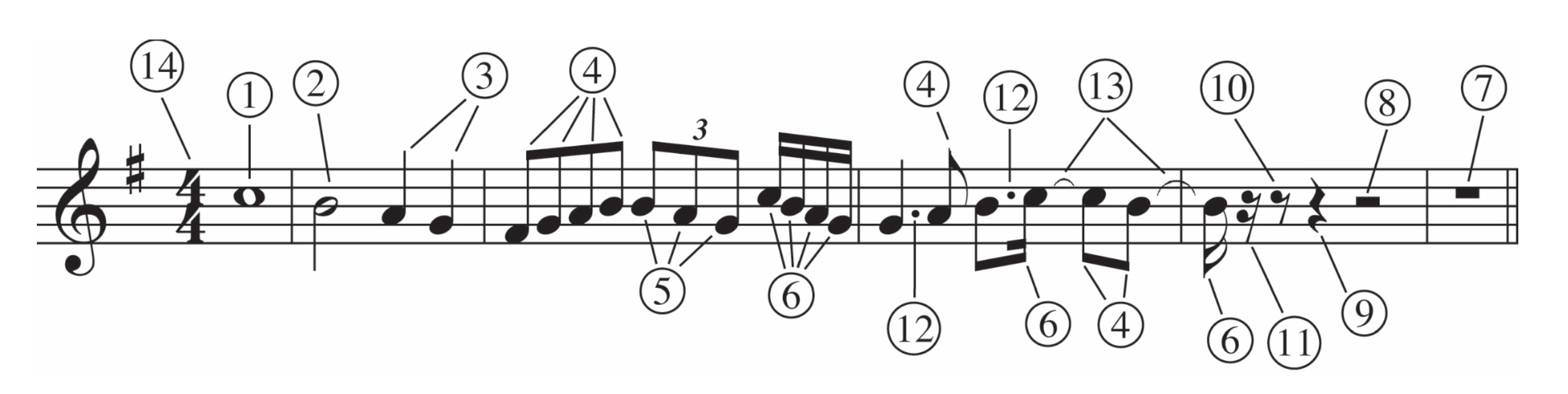
1 Whole note
An open note head with no stem; receives four beats in 4/4 time
2 Half note
An open note head with a stem; receives two beats in 4/4 A solid note head with a stem; receives one beat in 4/4
3 Quarter note
A solid note head with a stem; receives one beat in 4/4
4 Eighth note
A solid note head with a stem and one flag or beam; receives half a beat in 4/4
5 Eighth-note triplet
An eighth note grouped with other notes and appearing with the numeral 3, sometimes accompanied by a bracket, to indicate three eighth notes in the space of two eighth notes time
6 16th note
A solid note head with a stem and two flags or beams; receives one quarter of a beat in 4/4
7 Whole rest
A small rectangle that hangs down from a staff line indicating an entire measure rest in any meter
8 Half rest
A small rectangle that sits on a staff line indicating two beats rest in 4/4
9 Quarter rest
A symbol that indicates one beat of rest in 4/4
10 Eighth rest
A symbol that indicates a half beat of rest in 4/4
11 16th rest
A symbol that indicates a quarter beat of rest in 4/4
12 Augmentation dot
A dot appearing to the right of the note head or rest that tells you to increase the note’s or rest’s length by half of the original value. For example, a quarter note is one beat, so a dotted quarter note equals one and a half beats
13 Tie
A curved line joins two notes of the same pitch. You play the first note for its full value, and instead of restriking the second (tied) note, you let the note sustain for the combined value of both notes
14 Time signature
A two-digit symbol that appears at the beginning of the piece helps you count the beats in a measure and tells you which beats to stress, or give emphasis to. The top number indicates how many beats are in each measure, and the bottom number tells you what type of note (half, quarter, eighth, and so on) gets one beat. For example, in 3/4 time, you play three beats to the measure, with the quarter note receiving one beat. In 4/4 time, you play four beats to the measure, with the quarter note receiving the pulse or beat. Knowing how to read (and play according to) the time signature helps you to capture the feel of the music
explore more ...
songs

theory

exercises


